Sunday, February 10, 2019

February 10 - Townsend's Warbler

Today we went out southwest to Trenton to visit it's Sewage Treatment Plant.  I'm not kidding !
Attracted to the continually flowing water and the insects that thrive here all winter long was a western vagrant in the form of Townsend's Warbler.
This is my first east coast sighting of this species, and it is quite the beauty:


Afterward we went to Assunpink Wildlife Management Area to see the pair of Trumpeter Swans.
On our way back home we spotted a large flock of over 5,000 Snow Geese.  We scanned the flock for a bit and Andy was able to locate a Ross' Goose within the flock.

Sunday, January 13, 2019

January 13 - Shinnecock Inlet seabirds

Today was an exciting morning.  It's rare in this area to be able to enjoy so many seabirds from land. The inlet is hosting a Thick-Billed Murre for more than a week, and was recently joined by Common Murre.  These birds were seen along with the more-likely alcid species of Razorbill.
We also saw Black-Legged Kittiwake, and some Red-Necked Grebes.

img_5229

Thick-Billed Murre

My friend John's blog has more info on the day and some photos


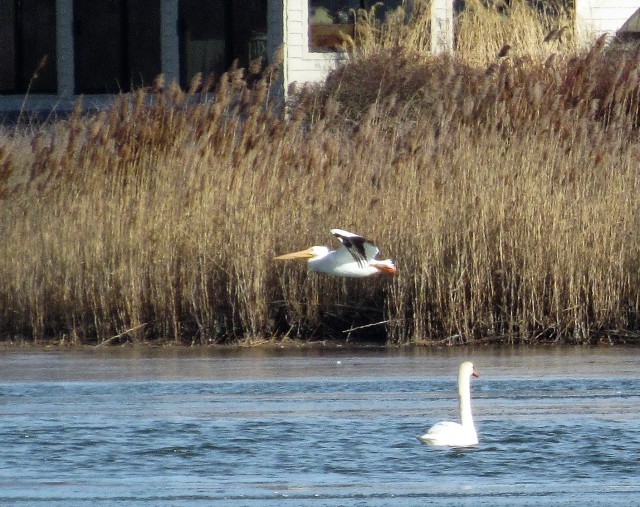
Later we went east to Watermill, NY and saw the American White Pelican that was found recently.

img_5255 (2)

Saturday, January 12, 2019

January 12 - Mega rarity in Upstate New York

Today I finally had a chance to try for the Golden-Crowned Sparrow that has been seen since the last few days of 2018.


Here is the Range Map for this species:
https://www.allaboutbirds.org/guide/Golden-crowned_Sparrow/maps-range

image of range map for Golden-crowned Sparrow


On the drive back southeast, we stopped in Parksville and saw a few dozen Evening Grosbeaks at the Woodard Road feeders.  We also had Pine Siskins at the Grants Road feeders.

Saturday, January 05, 2019

January 5 - Black Phoebe

I awoke to see the New Jersey Rare Bird Alert message that a Black Phoebe had been found !
This is remarkable as this species has not been known to be found outside it's normal range.  Oh well, I guess this guy is just confused and kept flying East.

The viewing conditions were very tough as it had been raining quite hard for over an hour while we waited to see this bird.  As soon as the rain lightened up, the bird was out catching insects along the pond that is in the Hainesville Wildlife Management Area.


Here is the known Range Map:


Tuesday, January 01, 2019

January 1 - Slow start to the New Year

The winter thus far has been very mild, so the birding got off to a slow start this year.

We then stopped at Stone Tavern Lake in the Assunpink Wildlife Management Area to get a peek at the pair of Trumpeter Swans here.   The Trumpeters are hanging around with the more common Mute Swan.


Saturday, December 15, 2018

December 15 - Winter specialties

Well, after a very long absence from 'sharing with you what my eyes see'  I'm writing about my day.
Friends and I went up north to Sullivan County, New York to the area of Liberty/Parksville for a chance to see some winter specialties. Our first stop was the Rayano Feeders at the junction of Smith Road & Cooley Road.  Almost immediately we heard the calls of our target bird of Evening Grosbeaks. We had 7 to start, and the flock then grew to 15+. 
This was just my 5th time seeing this species, and the second time here (2008 & 2018) at the Rayanos. It was see to see the 'House for Sale by Owner' signs posted as perhaps the next homeowner will not be interested in feeding birds.

We birded the local area without much else noteworthy to report, so we headed back south toward our homes in New Jersey. We made a stop at Kendridge Farm to try for the Northern Shrike that had been reported earlier in the morning.  As we were about the leave, Andy's sharp eyes found the Shrike perched atop a very tall tree. We then bumped into Matt who was also looking for the Shrike, and you can view Matt Zeitler's blog for images of the Northern Shrike:
http://orangebirding.com/?p=8805

Sunday, April 08, 2018

April 8 - Godwit Rarity

I began this morning at Garret Mountain to take in the arriving Spring birds along with my friend Bill E. 
There weren't a lot of species around yet we enjoyed the numerous Yellow-Bellied Sapsuckers as we walked to top ridge at Garret. Once we reached the lower section of the park we had a Blue-Gray Gnatcatcher.  The most action was at the bottom of Wilson Avenue where we had many Pine Warblers, Palm Warblers, a Yellow-Rumped, Brown Creepers, and both Kinglets.

I then saw a rare bird alert for a Black-Tailed Gowdit that had been found in Gloucester County's Pedricktown Marsh.  Twice previously I had tried to see this bird, one being in Massachusetts & the other attempt in Maryland, with both of those very long journeys being unsuccessful.  So discarding all logic & buoyed with hopes that 'the third time was the charm' I immediately took the hike straight up from Wilson Avenue and back to the very top of Garret Mountain, where I hopped into my car for the 115-mile drive down to southwestern New Jersey.
When I arrived in Pedricktown and it's Causeway, I met up with a few friends that had also been lured south by this rarity.  Unfortunately this marsh is tidal and by my midday arrival the tide was already out, which leaves too many other places for the birds to find better feeding opportunities than an empty mudflat.

After a short wait we all got a call from friend Larry S. that he and Steve G. had seen the bird very briefly in flight and they had found a trail that leads toward another section of the marsh that was not viewable from the Causeway. After a quarter-mile hike and then some bush-whacking, our group of a dozen hopeful birders were able to find a small clearing at the edge of the marsh and setup our scopes.  After a 30-minute wait one fellow said he could see the bird but that it had gone down into a channel before he could see it well. Thankfully after a short wait we were all able to see the tomato-colored head of the Godwit, albeit from a distance of about 250-300 yards.

A few folks then broke off in search of closer access to view the Godwit.  Shortly thereafter we were told of a way to get closer.  So, hiking back out the quarter-mile & then taking a half-mile hike into another section of the marsh, along with more bush-whacking we reach a small area that gave us very nice views of the Black-Tailed Godwit from about 60-75 yards distance.  While here we all had lovely views of the breeding plumaged bird, it's two-toned bill and other field marks.  All that was left was for the bird to take flight to show it's trademark tail.  After a few minutes that flight did happen as the bird flew even closer to us & we all had spectacular views of the tail and other markings that distinguish this bird.

Here's a photo from the e-bird checklist of John Stippick who discovered the bird today.