Today saw an early-morning drive down to Edwin B. Forsythe NWR, affectionately known as 'Brig".
My goal was to see the southbound shorebird migration that is getting underway.
I arrived just before 6:30 and got started with nice views of a Blue Grosbeak. Soon after I saw a Caspian Tern hunting over the marsh.
Next up was some Gull-Billed Terns before turning my attention to the most-recent rarities to be seen in the refuge..The expected species here is the Glossy Ibis (GLIB) however a pair of juvenile White Ibis (WHIB) have been seen for about a week now. These White Ibis have been faithful to the area near Goose Marker 5, and today was no exception. As I drove toward Marker 5 I saw the White Ibis in flight & they landed in the grassy marsh to feed.
Up the Wildlife Drive roadway about 200 yards further east I spotted the other recent rarity of the American Avocet. Soon after I spotted the over-summering, and presumed injured, Snow Goose by Marker # 7.
Later on the north dike I spotted a Marbled Gowdit that was feeding near the traditional Tern/Plover mudflat roosting area. I was glad that many others were able to see this bird later throughout the day.
Since I had not yet seen my friend Jason D. on the wildlife drive I took another quick loop of the refuge. On the north dike I ran into Jason, along with friend Chris and his wife Paula. Here those 3 showed me the White Faced-Ibis (WFIB) that had been reported yesterday.
So I was able to have a 3-Ibis species day in New Jersey, which is not a common occurrence!
Sunday, August 06, 2017
Sunday, July 16, 2017
July 16 - Liberty Marsh
After some time off from birding recently I was finally able to get out today. I went up north to the Wallkill River National Wildlife Refuge's Liberty Marsh section. This section straddles the stateline between NJ and NY.
The Liberty Loop is a few mile long trail that gives you access to some of the best freshwater marshes that are closest to my home.
My target was the Least Bittern and today I was able to have great views of a pair !
Also seen was a Common Gallinule/Moorhen, who finally made an appearance after 30 minutes of calls from within the reeds.
I also heard at least 3 different Sora rails, although none of these ever made an appearance.
The Liberty Loop is a few mile long trail that gives you access to some of the best freshwater marshes that are closest to my home.
My target was the Least Bittern and today I was able to have great views of a pair !
Also seen was a Common Gallinule/Moorhen, who finally made an appearance after 30 minutes of calls from within the reeds.
I also heard at least 3 different Sora rails, although none of these ever made an appearance.


Saturday, June 03, 2017
June 3 - Local Specialties & A pair of Rarities
With the northbound migration almost completed June becomes the time of year where I look for the local specialties & the local-breeders, which we are fortunate to have many species of !
Our first stop today was along Ironwood Drive in Sterling Forest. Here we saw the expected, yet quickly diminishing, specialties of Golden-Winged Warbler.

We also had point-blank views of a lovely male Cerulean Warbler after he had come down to bathe.

Next we headed up to Ulster County, New York to visit the Shawangunk National Wildlife Refuge.
Here for several days have been two rarities and fortunately I was able to catch up with them before their departure !
The first rarity is the Dickcissel. Typically this species breeds in the Central US, so to have a singing male that is defending it's breeding territory in NY State is unusual.
Click on the maps/images below to enlarge.

Here's the Dickcissel:

credit: Bill Elrick
The other rarity was also present, and just about 100 yards away ! This species is the Henslow's Sparrow. This species can & does breed here in New York State however there is a very small population of these birds on the eastern edge of their range as they require large tracts of grassland.

Here is the Henslow's Sparrow:
Note the greenish nape/neck & the dark spot on the cheek.

credit: Bill Elrick
Our first stop today was along Ironwood Drive in Sterling Forest. Here we saw the expected, yet quickly diminishing, specialties of Golden-Winged Warbler.

We also had point-blank views of a lovely male Cerulean Warbler after he had come down to bathe.

Next we headed up to Ulster County, New York to visit the Shawangunk National Wildlife Refuge.
Here for several days have been two rarities and fortunately I was able to catch up with them before their departure !
The first rarity is the Dickcissel. Typically this species breeds in the Central US, so to have a singing male that is defending it's breeding territory in NY State is unusual.
Click on the maps/images below to enlarge.

Here's the Dickcissel:

credit: Bill Elrick
The other rarity was also present, and just about 100 yards away ! This species is the Henslow's Sparrow. This species can & does breed here in New York State however there is a very small population of these birds on the eastern edge of their range as they require large tracts of grassland.

Here is the Henslow's Sparrow:
Note the greenish nape/neck & the dark spot on the cheek.

credit: Bill Elrick
Thursday, June 01, 2017
June 1 - Lesser Nighthawk
Having been out-of-state for the past week today was my first chance to try for the mega-rarity that had been reported since last week. New Jersey's second known record of a Lesser Nighthawk had been reported from Somerset County's Lord Stirling Park. Evidently an injured bird had been found earlier in May and brought to the nearby Raptor Trust. Here the bird was rehabilitated and subsequently released at the Great Swamp National Wildlife Refuge.
The bird apparently settled in at Lord Stirling park, which is about one-mile away from it's release. Fortunately for me the bird stuck around long enough that I could give it a go. I did see the bird straight away.
 credit: Me
The bird was seen once more the next evening, and not since !
Here's the bird's typical range:

The bird apparently settled in at Lord Stirling park, which is about one-mile away from it's release. Fortunately for me the bird stuck around long enough that I could give it a go. I did see the bird straight away.

The bird was seen once more the next evening, and not since !
Here's the bird's typical range:

Sunday, May 28, 2017
May 27 & 28 - Hatteras Pelagics
I was able to cross off an item from my Birder's Bucket-List by finally getting down to the Outer Banks of North Carolina, specifically the island of Cape Hatteras.
My first scheduled boat trip was cancelled due to strong winds coming from the West. I was able to re-schedule and thus went two straight days !
Unfortunately for me the strong westerlies had blown all of the deep-water specialty birds further east and away from the Gulf Stream. Nevertheless I did manage one life bird in the Black-Capped Petrel.
We saw dozens of these birds, and at quite close range over the two days.
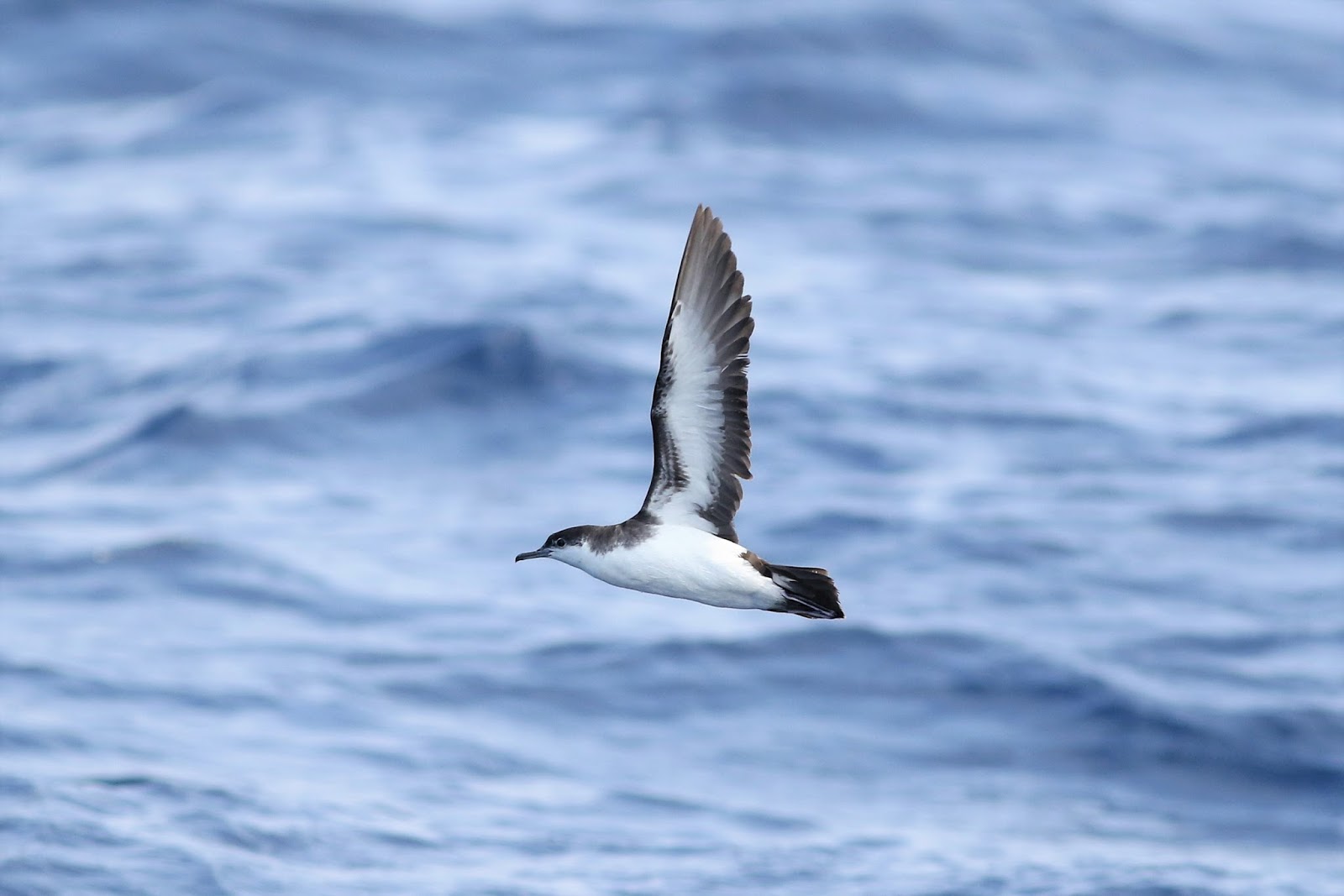
Other species seen were Sooty Shearwaters, Cory's Shearwaters, Audubon's Shearwaters, Wilson's Storm-Petrels, and several Band-Rumped Storm-Petrels.
So, it was not quite the adventure I had hoped for, but the one that I had expected. The open ocean of the Gulf Stream that is 30-miles offshore is rather like a liquid-desert. There's a lot of territory between where you are & where the birds are...
Band-Rumped Petrels:


Sooty Shearwater:

Black-Capped Petrel:


Audubon's Shearwater

My first scheduled boat trip was cancelled due to strong winds coming from the West. I was able to re-schedule and thus went two straight days !
Unfortunately for me the strong westerlies had blown all of the deep-water specialty birds further east and away from the Gulf Stream. Nevertheless I did manage one life bird in the Black-Capped Petrel.
We saw dozens of these birds, and at quite close range over the two days.
Other species seen were Sooty Shearwaters, Cory's Shearwaters, Audubon's Shearwaters, Wilson's Storm-Petrels, and several Band-Rumped Storm-Petrels.
So, it was not quite the adventure I had hoped for, but the one that I had expected. The open ocean of the Gulf Stream that is 30-miles offshore is rather like a liquid-desert. There's a lot of territory between where you are & where the birds are...
Band-Rumped Petrels:


Sooty Shearwater:

Black-Capped Petrel:


Audubon's Shearwater
Saturday, May 06, 2017
May 6 -Veni, Vidi, Vici !
Avenged ! Following my miss of New Jersey's First State Record of the species of Little Egret on April 28, the bird was re-found once again visiting Heislerville WMA on Thursday evening and was then reported again on Friday (yesterday)..So my friends and I decided to give this bird another try.
We began our morning at the relatively nearby to Heislerville birding area of Belleplain State Forest. Here we sought out and found the specialty of this forest, the Yellow-Throated Warbler. We heard, but did not see a Prothonotary Warbler...
Next we moved onto Heislerville WMA and found there to be quite a gale blowing. We also heard that the Little Egret was seen moments ago and had flown into the marsh. We then drove up on the dirt road separating the tidal impoundment & the marsh and we connected with the bird !!
 credit Bob Brown
This species is my 648th official ABA-species !!
We began our morning at the relatively nearby to Heislerville birding area of Belleplain State Forest. Here we sought out and found the specialty of this forest, the Yellow-Throated Warbler. We heard, but did not see a Prothonotary Warbler...
Next we moved onto Heislerville WMA and found there to be quite a gale blowing. We also heard that the Little Egret was seen moments ago and had flown into the marsh. We then drove up on the dirt road separating the tidal impoundment & the marsh and we connected with the bird !!

This species is my 648th official ABA-species !!
Sunday, April 16, 2017
April 16 - Garret Mountain
The annual ritual of birding Garret Mountain Park has returned. I have been visiting the park a few times recently.
The first time was on March 29 because my friend Bill E. had seen an American Bittern in the phragmites at the north end of Barbour Pond, so I went there the next morning before work and was able to see the bird.
Since April started I have made a few visits, with last weekend rewarding me with Louisiana Waterthrush, Pine Warbler, Palm Warbler, Blue-Gray Gnatcatcher, Eastern Phoebe, Winter Wren, and Northern Rough-winged Swallows
With mid-April now here the new birds are starting to arrive daily. This weekend brought in Blue-Headed Vireos, Purple Finch, and my earliest-ever Northern Waterthrush.
 credit: http://www.lilibirds.com
I'll start going daily before work beginning tomorrow.
The first time was on March 29 because my friend Bill E. had seen an American Bittern in the phragmites at the north end of Barbour Pond, so I went there the next morning before work and was able to see the bird.
Since April started I have made a few visits, with last weekend rewarding me with Louisiana Waterthrush, Pine Warbler, Palm Warbler, Blue-Gray Gnatcatcher, Eastern Phoebe, Winter Wren, and Northern Rough-winged Swallows
With mid-April now here the new birds are starting to arrive daily. This weekend brought in Blue-Headed Vireos, Purple Finch, and my earliest-ever Northern Waterthrush.

I'll start going daily before work beginning tomorrow.
Subscribe to:
Posts (Atom)
